Showing posts with label Storyboarding. Show all posts

Wednesday, 12 April 2017

Shot Variety

When first planning and storyboarding our opening, I wanted to follow the rough outline of conventional shot sequences however use rapid straight cuts between varying shots to capture the emotional intensity we decided upon.

Dazed begins with a tilt shot into the opening establishing shot of the block of flats displaying the title itself. In the following party sequence we used consistent (extreme) close ups in the glitch sequence before contrasting to the full body and POV running sequence. The obscurity of the protagonist was emphasised through choices in cinematography in the section filmed on the roof. Though planned later on, we had a variation of over the shoulder, POV and close up shots countered by a wide shot zooming out to end the opening. As well as this we explored camera angles as well with as low and high angle shots whereas previously a substantial amount of the opening was filmed at eye level.  
 

Friday, 14 October 2016

Storyboarding our film opening


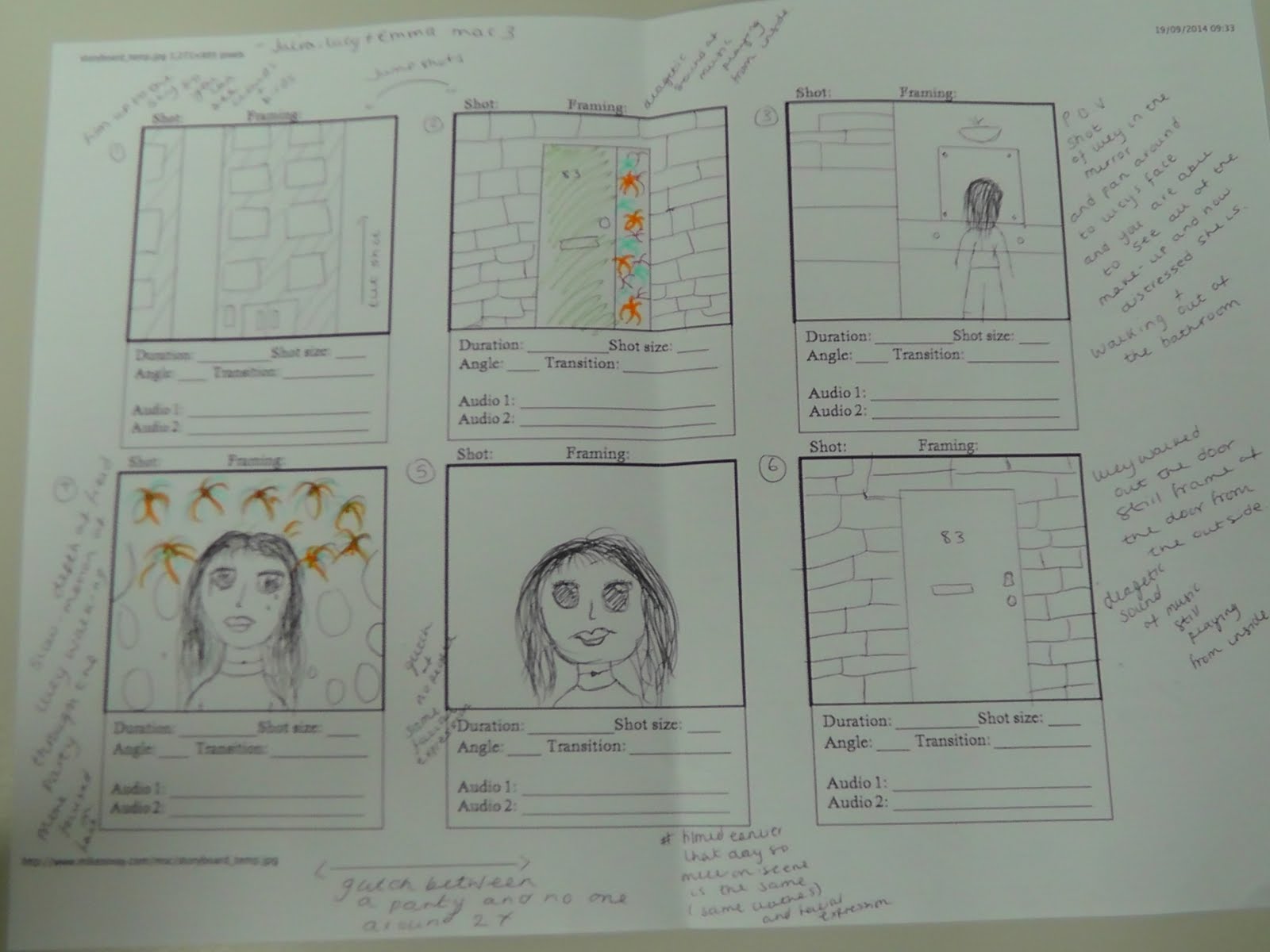
Below is a compilation of the individual shots with desired sound effects, a rough outline of our film opening. Though the clip is not the full two minutes, we will be including use of pan and tilt shots which we are unable to demonstrate in storyboarding meaning it is substantially shorter. As well as the storyboarding, this post includes our pitch to provide a deeper explanation of the film and our focuses on lighting to convey an overall focus on state of mind in a character driven film opening. The most challenging aspect of our film opening will be a glitch within the editing to further the idea of confusion and distress. Continuity and focus on the mise en scene when shooting the party scene (shots 2, 4,5,6) will be crucial if the glitch is to be the most impressive aspect of the opening. Therefore, over the half term and after filming, I will need to research how to edit the clips in the most professional way possible. As well as this, I will look into hue and intensity of lighting in both films and television for inspiration in establishing tone and mood.
 
1. A tilt shot of the outside of a block of flats, set in the evening with dim lighting.
 
2.The outside of a front door slightly open, meaning the flashing lights are slightly visible accompanied by the sound of thumping music.

3.Cuts abruptly to the bathroom, my character staring into a mirror clearly distressed, tracking me out into the party. 

4. Shots four and five continuously switch between the two to create the glitch to express the protagonists state of mind, similarly demonstrated through lighting.

6. She (my character) walks back out through the front door but after the character slams the door, the camera will linger on the shot as we saw in a clip from Luther from under the bed.

7.Next, an overhead shot birds eye view running down the stairs, the camera will not track so the only movement will be by character running. 

8. Walking out of the door of the flats.

9. A shot from the top of the stairs  at a high angle watching my character going down the stairs.
 
10. Following that, shot of the girl (played by Helin) looking confused in response.
 
11. In conjunction with shot ten is one from the unnamed girl character's point of view looking at my character at the bottom of the stairs.

12. A low angle shot of me at the bottom of the stairs with the same of deep breathing before beginning the running sequence.

13. The use of a dolly shot following me from behind while she is running. We intend on using hand held at points to convey the panic.

14. A wide shot of me running in then quickly out of the frame.

15. Then a close up of my face still running but then transitioning to the next shot whilst her phone rings.

16. Abrupt cut to a black screen with only the sound of panting and the words "I need your help."


Friday, 16 September 2016

Storyboarding Remember Me


As well as being introduced to camera shots, in the lesson we watched the opening scene of the BBC programme Remember Me. Whilst watching the clip, we filled out a storyboard for each new shot containing as much detail as possible. Doing activity helped me understand the level of detail I'll need to include when working on our groups film opening.
The opening of Remember Me was such an interesting scene to watch as it built so much tension through the varied speed of scenes and mood created by the establishing shots. The older man who appeared to be the protagonist of the story had no dialogue but the later introduction of the ghost leaves so many questions to be answered.

The trickiest part I found in storyboarding, as shown above, was when the camera would tilt or pan within one shot. To demonstrate this I annotated as much as possible alongside use of arrows.