
Showing posts with label Directors. Show all posts
Showing posts with label Directors. Show all posts
Tuesday, 18 April 2017
Presence of Women in Star Wars
After
watching the recently released teaser trailer for Star Wars: The Last Jedi, I
began to look into the growing presence of women both on screen and behind the
scenes of the franchise. The Force Awakens (2015) introduced the character Rey
played by Daisy Ridley and her plotline is likely to develop significantly in
the next episode. I particularly liked Rogue One (2016), revolving around the
character Jyn Erso played by Felicity Jones, as it was a much more personal
take on the conventions of the films. Jones' character is portrayed as an
incredibly strong individual both physically and mentally. In shaping the
character, director Gareth Edwards said he wanted to avoid the mistakes often
made when writing female characters. I also found a really interesting article
in the New York Times about women in Star Wars, with particular focus on those
working behind the camera.


Wednesday, 12 April 2017
Wes Anderson
At the moment, two of my favourite directors are Damien Chazelle and Wes Anderson. Though heavily different in genre, the definite focus of their films and choices in cinematography draw me to their films.
The often abstract nature of Wes Anderson's films has allowed them to develop their own independent style beyond the conventions of established cinema. The random, abrupt straight cuts between shots and often absence of long takes is directly reflected in the development of characters. The only way I can really describe Anderson's work is bizarre. The vibrancy of colour palette and subverting of film conventions is consistent in his work. His 2012 feature Moonrise Kingdom and The Grand Budapest Hotel of 2014 are both told to the audience by a narrator. Not an omniscient narrator but one active in the plot, breaking the so called fourth wall.
Real, meaningful character relationships are developed on the most surreal backdrop. Anderson cleverly balances both comedy and drama. One key channel for this in The Grand Budapest Hotel, in my opinion, is the relationship between M. Gustave and Zero.The immense shot variety is what I love about these films (alongside the abundance of quirky characters). Constant change of perspective and audience positioning fully immerses them in the story. For me, I feel like a fly on the wall watching the events unfold whilst other times(particularly in Moonrise Kingdom) I feel like one of the characters in the film. The opening to Moonrise Kingdom sees a fluid pan across a house, room to room almost like a dolls house. This is followed by close ups, POV shots, shot reverse shot, any shot you can think of!!!


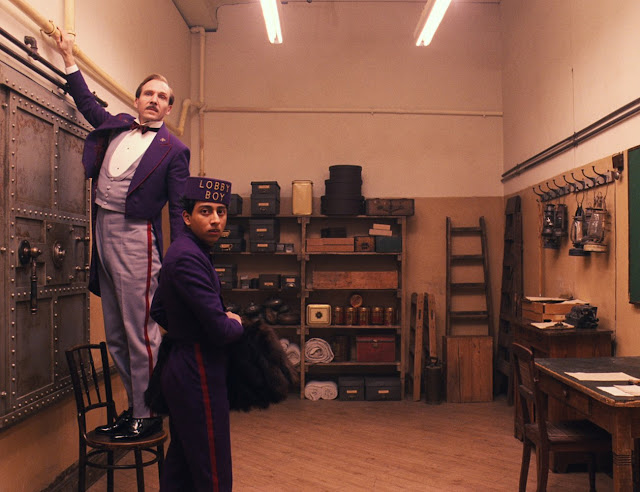

The often abstract nature of Wes Anderson's films has allowed them to develop their own independent style beyond the conventions of established cinema. The random, abrupt straight cuts between shots and often absence of long takes is directly reflected in the development of characters. The only way I can really describe Anderson's work is bizarre. The vibrancy of colour palette and subverting of film conventions is consistent in his work. His 2012 feature Moonrise Kingdom and The Grand Budapest Hotel of 2014 are both told to the audience by a narrator. Not an omniscient narrator but one active in the plot, breaking the so called fourth wall.
Real, meaningful character relationships are developed on the most surreal backdrop. Anderson cleverly balances both comedy and drama. One key channel for this in The Grand Budapest Hotel, in my opinion, is the relationship between M. Gustave and Zero.The immense shot variety is what I love about these films (alongside the abundance of quirky characters). Constant change of perspective and audience positioning fully immerses them in the story. For me, I feel like a fly on the wall watching the events unfold whilst other times(particularly in Moonrise Kingdom) I feel like one of the characters in the film. The opening to Moonrise Kingdom sees a fluid pan across a house, room to room almost like a dolls house. This is followed by close ups, POV shots, shot reverse shot, any shot you can think of!!!


Friday, 31 March 2017
Danny Boyle
In class, we recently watched 127 Hours (2010) and The Beach (2000) both directed by Danny Boyle. His style of film is made blatantly clear in the hyperactivity of sequences with consistent rapid straight cuts. Contrast between the realism of often isolated natural settings with abstract edited sequences assisted by contrapuntal sound is evident in both features.
127 Hours use of split screens and contrast in colour palette:


127 Hours use of split screens and contrast in colour palette:


Wednesday, 9 November 2016
Damien Chazelle: Whiplash and La La Land
The director and writer of the film, Damien Chazelle was initially unable to gain funding for the release of Whiplash so he instead turned it into a short film and entered his work into the Sundance Film Festival in 2013. The film won the Short Film Jury Award, and as a consequence he gained funding with an eventual budget of an $3.3 million. "I think it's a great film to open up Sundance because we made it in 19 days, and they edited it in nine weeks, which is unheard of. So, it took a lot of grit and hard work to get us here," Miles Teller told The Hollywood Reporter at the film's after party. Whiplash was released in the USA on October 10th 2014 and 16th January 2015 in the UK. In the opening weekend it accumulated $135,888. Grossed nearly $50 million worldwide.
I first watched the film shortly after its UK release in 2015, and my first thought was that I'd never seen such tension or anticipation in a film not associated with the horror genre. Use of straight cuts between shots in quick succession and parallel editing enhance the tension provided by Miles Teller's and J K Simmons' performances. This is demonstrated perfectly in the short clip above. An establishing shot of the stage, cutting to an over the shoulder shot of Simmons' character Fletcher in the foreground, pausing for a second before focus is given to Andrew on the drums in spite of the clearly clenched fist dominating about a third of the shot. All of this occurs in the first five seconds of the scene, capturing the rapid pace of the film accompanied by the drums reoccurring presence. Lights dim, but neither character alters their position or expression leaving the audience waiting, as the drums continue. A low angle shot of Andrew is followed by one of my favourite shots, a tracking POV shot of the drum set where it seems the camera can't quite keep up then cutting to a birds eye view of the drum set. Similar close ups are repeated throughout the film to capture the emotional intensity that drives this film. From the point of around 1:40 minutes in the clip, the choice to have no other sound but the drums for a short while, with no enhanced sound of breath or reaction from ensemble aids the camera work in illustrating Andrew's determination and focus the story thrives on.


Aside from the camera work, the very message of the story is what makes it one of my favourites. No, its not a light hearted easy watch but that's what I love about it. It challenges the concept of the American Dream, channelling this idea through the character of Fletcher. He enforces the idea that it takes a lot to be great, beyond skill you require luck. In the setting of a school filled with an abundance of talented students Teller's character is pushed to the edge in order to see himself succeed. Andrew encapsulates the idea of passion, continuously hindered by the words and spitefulness of Fletcher. By doing so Chazelle makes it very easy for the audience to identify with the topic of the film, taking an immediate almost furious dislike to J K Simmons' character. My favourite quote from the film reads "I'd rather die drunk, broke at 34 and have people at a dinner table talk about me than live to be rich and sober at 90 and nobody remembered who I was"

Similarly to Whiplash, Damien Chazelle's upcoming film La La Land tells a story driven by the ambition of its two protagonists, a jazz pianist and an aspiring actress. The film has received five star reviews and especially following an advanced screenings at the BFI film festival 2016, a hype has been created around the its upcoming release. The film is set to be released in the USA on December 16th 2016 and January 13th 2017 in the UK. As shown in the poster below, Chazelle's newest project has received not only astounding reviews but also multiple wins, creating high expectations for the awaiting audiences and success at events such as the Oscars. Many have said it's set to dominate such award ceremonies in the year to come.

Subscribe to:
Posts (Atom)